CV is not measuring the skills AI cannot replace.


Part two of two. Part one asked whose record it is. This part asks what AI has quietly done to the list of things that matter at work, and why the document meant to prove you have them has not been built to show it.
Article 19(1)(g) of the Constitution gives every citizen the right to practise any profession.¹ No court case is needed to defend that right, because no statute ever took it away. What's quietly narrowing it is something far less dramatic: the tools companies use to decide who gets to practise where, and how badly those tools actually work, at the exact moment what they're supposed to be measuring has started to change.
The document deciding your next move was never good at its job
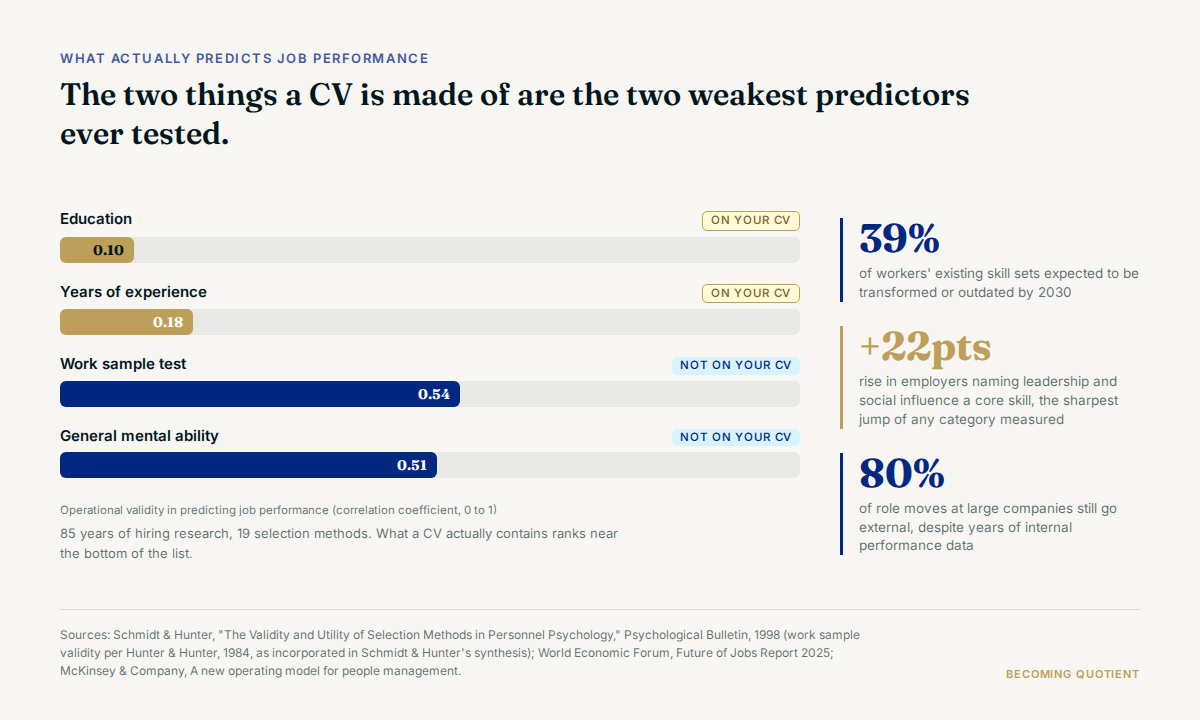
In 1998, Frank Schmidt and John Hunter published a meta-analysis pulling together 85 years of hiring research across 19 selection methods, one of the most cited pieces of work in industrial psychology.² They ranked every method by how well it actually predicted job performance. Years of experience: a correlation of 0.18. Education: 0.10. Both sit in the range researchers themselves call barely useful. Structured interviews and cognitive testing, by contrast, land three times higher.
Experience and education are, almost exactly, what a CV contains. The document was never a strong predictor of whether someone can do the job. That has little to do with portability. Even read by a company that has known you for a decade, it was never a particularly reliable signal in the first place.
What AI is quietly rewriting the job description for
None of what follows is happening in a vacuum. The reason resilience and learning agility are suddenly worth screening for is the same reason a CV is suddenly worth less: artificial intelligence is absorbing the routine, technical layer of most jobs faster than most people expected, and what's left over afterward is precisely the layer a CV was never built to show.
The World Economic Forum's 2025 Future of Jobs report puts a number on the churn, 39% of workers' existing skill sets are expected to be transformed or made outdated by 2030, and it finds leadership and social influence rose 22 percentage points as a skill employers name as core, the sharpest jump of any category measured.³ As the technical layer of a job gets automated, compressed or handed to a model, what's left to actually differentiate one candidate from another is judgment under pressure, the speed at which someone learns a tool they didn't grow up using, and what they do the day the process they relied on stops working. None of that has ever had a line on a resume.
This is starting to show up in how employers actually hire, not because anyone sat down and rewrote the CV, but because employers have simply, quietly, stopped trusting it. TeamLease EdTech's 2026 survey of more than a thousand employers found learning agility, the ability to pick up something new without hand holding, is becoming a baseline hiring expectation rather than a bonus.⁴
Mercer Mettl's research points the same way: resilience, adaptive learning and digital fluency are rising alongside technical skill in what employers actually screen for.⁵ Resilience is a pattern, visible only if someone was watching for it over time, under some kind of pressure, which is exactly what a document listing job titles and dates was never designed to capture.
The new tests only watch one door
Because none of this can be read off a document, a whole industry of bolt-on testing has appeared to compensate, adaptability scores, learnability assessments, structured simulations.⁶ No company issued a statement declaring the CV insufficient. They just quietly built a parallel system and started trusting that instead, which says more than any statement would have.
But that new infrastructure sits almost entirely at the front door. HR leaders say this plainly when asked, internal candidates typically face no equivalent testing, while external ones are run through a full assessment.⁷ Executive search research describing the same gap recommends the obvious fix, evaluate internal and external candidates on identical tools, and notes how rarely that actually happens.⁸
A test taken once, cold, by someone the company has never watched work, produces a score, but not real knowledge of her resilience or judgement. It's a guess dressed up as a number. What companies do have, for the people already inside, is the actual thing: years of watching a person hold up under real pressure, repeatedly, in full view. It's just never been written down, scored, or attached to a name. So the decision ends up resting on the guess or instinct, rather than the real evidence that never got captured at all.
The business is already paying for this
McKinsey's research on internal mobility found more than 80% of role moves at large companies still go external.⁹ Some of that is a company simply failing to search its own records. Part of it is sharper than that: the company built its newest, best measurement tools for the hiring gate and never turned them inward, so when a role opens, the outside candidate arrives holding a score and the inside candidate arrives holding a memory people have of her. A score beats a memory almost every time. That has nothing to do with the outsider being better. It's that she's the only one measured on the terms the decision actually runs on now.
What it does to the person, not just the numbers
There's a cost here that doesn't show up on a spreadsheet. Psychologists have known for decades, going back to Bandura's work on self-efficacy, that a person's belief in their own competence isn't purely internal. It's built and sustained through mastery experiences being recognised, tested against real feedback from the outside world.¹⁰ Self-determination theory names competence as one of three basic psychological needs, alongside autonomy and connection to others, and finds that when the need for competence goes unmet, motivation and persistence erode with it.¹¹
Put plainly: people need to see their own capability reflected back at them by something outside their own head, or their confidence in it starts to wear thin, whatever their actual track record says.
Now put a person inside a system that has no mechanism for reflecting that back, at the precise moment the traits she'd most want reflected are the ones AI can't touch. Ofer Sharone's research on long-term unemployment among experienced professionals describes exactly this: from the outside, a career gap looks identical whether it came from a business decision or a performance one, so the market stops trying to read the difference and defaults to treating the gap itself as the signal.¹² The person on the inside knows precisely what she did in the years that preceded it. The market, and increasingly her own sense of herself, cannot access any of that.
The freedom to practise, made practical
Article 19(1)(g) was never going to be the thing standing between a person and her next role. What's actually standing there, most days, is a resume with weak predictive power, built for a world where the job stayed the same for thirty years, an assessment layer built to judge outsiders and blind to insiders, and a market that reads silence as evidence of nothing good. AI didn't create this gap. It just made the skills sitting inside it worth more than they've ever been worth, at the exact moment the document meant to show them off was never built to see them.
Endnotes
- Constitution of India, 1950, Article 19(1)(g).
- Frank L. Schmidt and John E. Hunter, "The Validity and Utility of Selection Methods in Personnel Psychology: Practical and Theoretical Implications of 85 Years of Research Findings," Psychological Bulletin, 124(2), 1998, pp. 262 to 274. https://doi.org/10.1037/0033-2909.124.2.262
- World Economic Forum, Future of Jobs Report 2025, published 7 January 2025. https://www.weforum.org/publications/the-future-of-jobs-report-2025/
- TeamLease EdTech, Career Outlook Report, HY1 2026 (January to June 2026), published February 2026. https://www.teamleaseedtech.com/pdf/cor-jan-june-2026.pdf
- Mercer Mettl, India's Graduate Skill Index 2025, published February 2025. https://resources.mettl.com/research/india-graduate-skill-index-2025/
- AQai, Adaptability Quotient assessment, an example of a validated instrument built specifically to measure adaptability outside resume-based signals. See "How to Master Workplace Adaptability in 2026," 2026. https://internalchange.com/how-to-master-workplace-adaptability/
- HRKatha, "Why Have Different Evaluation Parameters for Internal and External Hires?", 10 November 2021. https://www.hrkatha.com/features/why-have-different-evaluation-parameters-for-internal-external-hires/
- Odgers, "Are You Evaluating Internal and External Candidates on the Same Level Playing Field?", 12 January 2024. https://www.odgers.com/en-us/insights/are-you-evaluating-internal-and-external-candidates-on-the-same-level-playing-field/
- McKinsey & Company, "A New Operating Model for People Management: More Personal, More Tech, More Human," 2025. https://www.mckinsey.com/capabilities/people-and-organizational-performance/our-insights/a-new-operating-model-for-people-management-more-personal-more-tech-more-human
- Albert Bandura, "Self-Efficacy: Toward a Unifying Theory of Behavioral Change," Psychological Review, 84(2), 1977, pp. 191 to 215; and Self-Efficacy: The Exercise of Control (New York: W.H. Freeman, 1997).
- Edward L. Deci and Richard M. Ryan, "The 'What' and 'Why' of Goal Pursuits: Human Needs and the Self-Determination of Behavior," Psychological Inquiry, 11(4), 2000, pp. 227 to 268.
- Ofer Sharone, The Stigma Trap: College-Educated, Experienced, and Long-Term Unemployed (Oxford University Press, 2024).