You know your job. But do you know yourself?


You understand your job in extraordinary detail. Title, notice period, vesting date, the politics of every meeting. But how well do you actually understand yourself?
The US quits rate was just 2.0% in June, the lowest in years.¹ At the same time, a FlexJobs survey of 1,701 workers found more than half said they were looking at new jobs every day.¹ India tells a version of the same story. Attrition fell to 16.2% in 2025, the lowest in five years, down from 18.7% in 2023, according to Aon's survey of more than a thousand Indian companies, and roughly three-quarters of Indian exits remain voluntary, a notably higher share than the 50 to 66% typical in global markets.² The workplace shorthand for all this is job hugging, people staying put, unhappily, because the market has made leaving feel riskier than it used to.
But the labour-market data can only tell you that people are moving less. It cannot tell you why you, specifically, are still here.
The more interesting question underneath it
Most people who feel stuck reach for one of two explanations. Either "I want to leave but can't afford to," or "I don't know what else I'd do." Both feel like external problems, about money, about the market, about options that don't exist. But there's a version of this that isn't about the market at all, and it's the one worth sitting with properly:
You cannot make a good career decision if you understand the job better than you understand yourself.
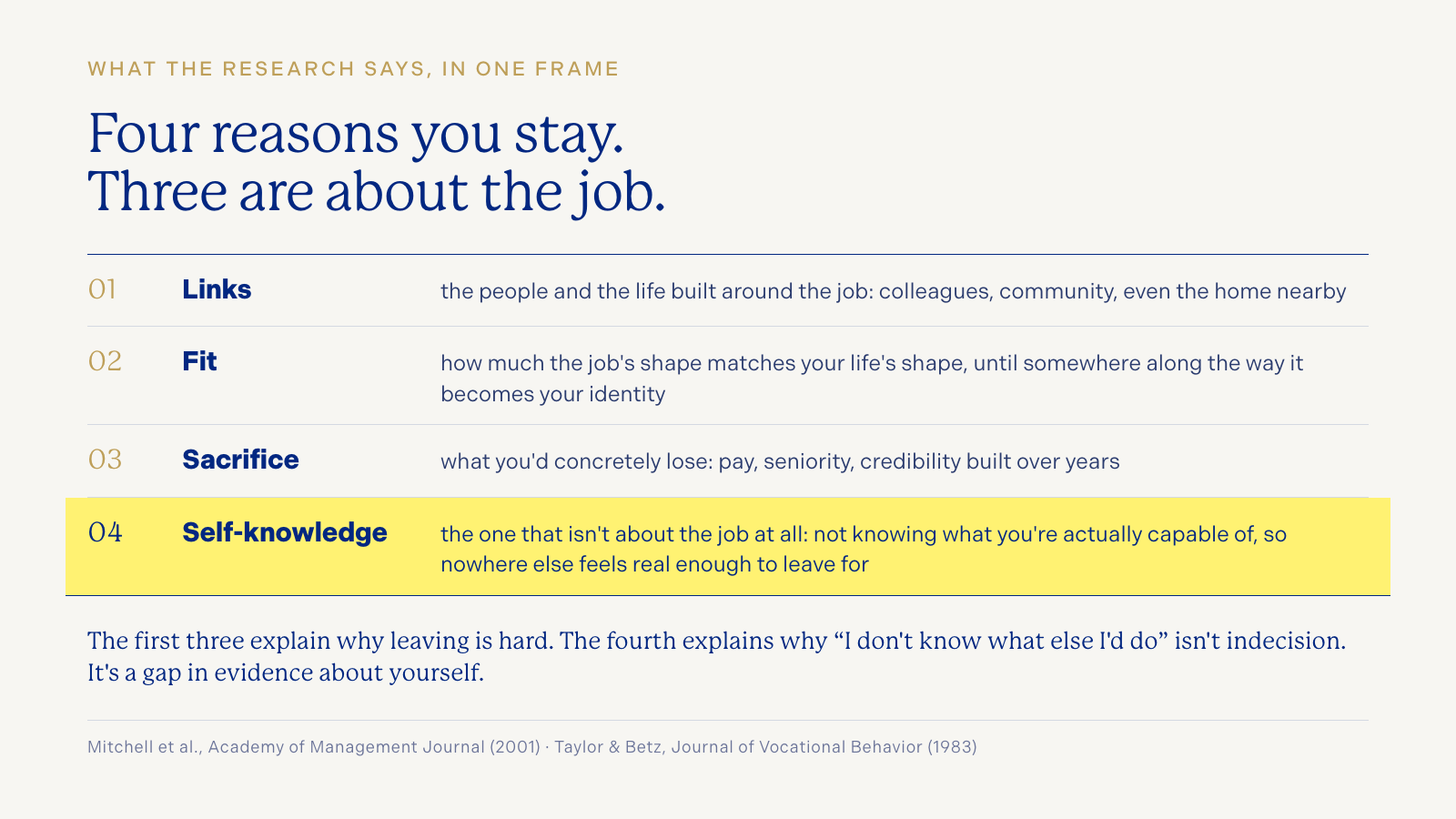
Most of us could describe our current role in forensic detail, the reporting lines, the politics, the unwritten rules of who to loop in before a decision. Ask the harder question, what are you actually capable of now that you weren't five years ago, what drains you versus what energises you, which parts of how you see yourself came from you and which were handed to you by a title, and the answer gets much thinner, much faster. That gap, knowing the job cold and knowing yourself only vaguely, is where "I don't know what else to do" actually comes from more often than people realise.
Why leaving is hard: the research on staying
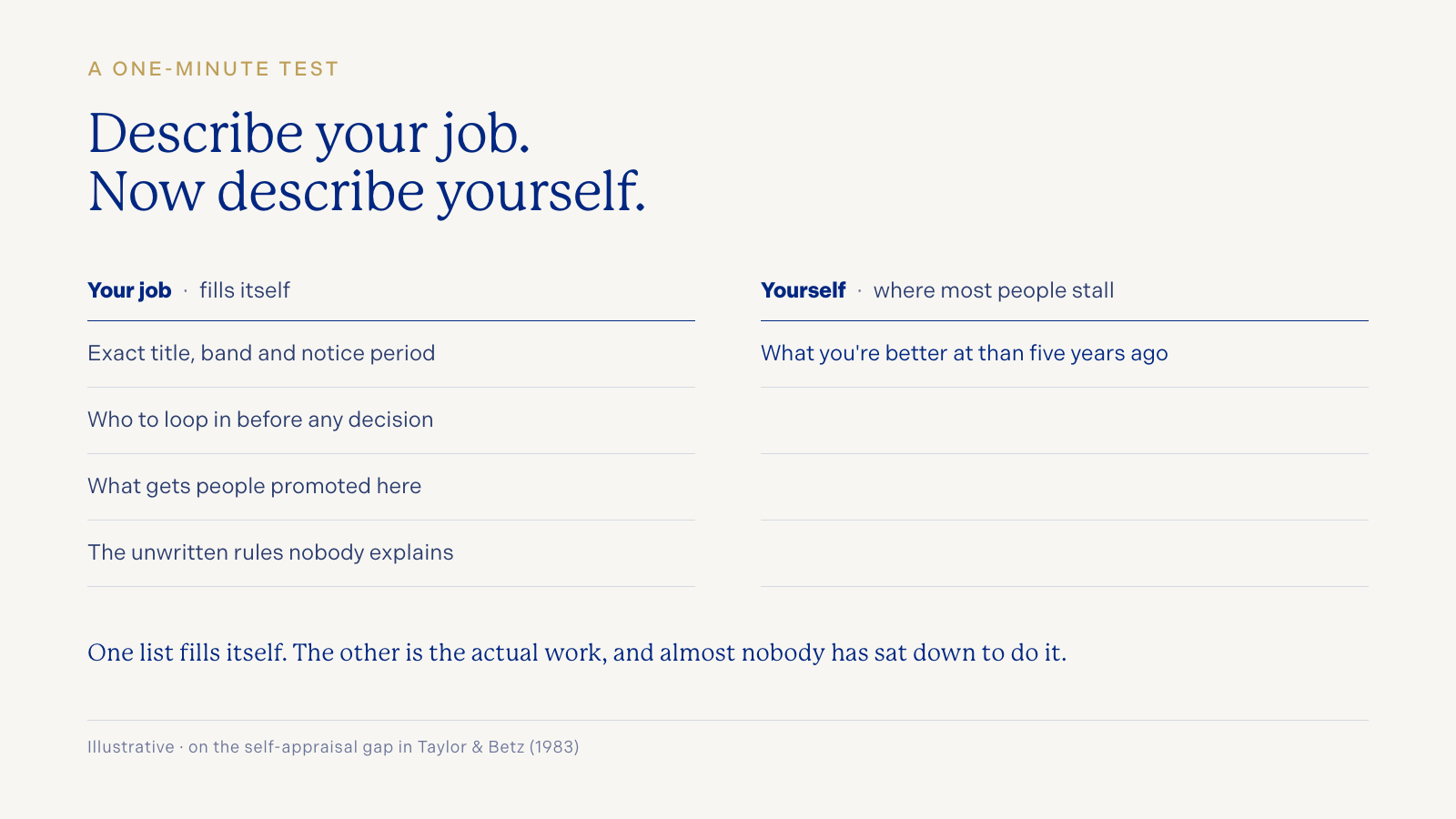
There's real, well-established research on why people stay in jobs, separate from whether they're happy in them. In 2001, organisational psychologist Terence Mitchell and colleagues introduced job embeddedness, a framework built specifically to explain retention, and it's held up well since, predicting who stays even after accounting for stated satisfaction.³ It names three forces, and each one applies both to your workplace and to your life outside it.
Links. The people you'd be walking away from. Not just colleagues, the framework explicitly includes family, friends, community, even something as concrete as owning a home nearby. Leaving a job rarely means leaving a role. It usually means unpicking a life that's grown up around it.
Fit. How compatible your work has become with the rest of your life, your values, your ambitions, the way you like to work, even where and how you live. The original research means something broader than "do you like the work," it's asking whether the whole shape of the job still matches the whole shape of your life. There's a further layer worth naming, one the original theory doesn't quite capture: sometimes fit becomes identity. You stop saying you work as a lawyer, or a banker, or an engineer, and somewhere along the way start believing you are one. Leaving then feels less like changing employers and more like giving something up.
Sacrifice. What you'd concretely lose, pay, seniority, a vesting schedule, credibility you've spent years building. This is where money and stability live, and it's usually the easiest of the three to say out loud, which is probably why it's the one people lead with.
Most people can locate themselves somewhere in these three without much difficulty, and none of it makes you weak or unambitious. It makes you a person weighing something real.
What links, fit and sacrifice can't tell you
Here's the limit of that framework, honestly stated: it explains why leaving is difficult. It cannot tell you whether staying is right. For that, you need to know something harder to research and much easier to avoid, yourself.
The strange thing about careers is that we keep updating our CVs constantly and rarely update our understanding of ourselves at anything like the same rate. The document changes every year, sometimes every few months. The internal picture often doesn't move at all.
You likely know your salary, title, notice period and vesting date with total precision. Try a different set of questions instead. What are you significantly better at today than five years ago? What kind of problem now brings out your best thinking, versus the kind that used to? What gives you energy rather than just proving you're competent? What do people quietly trust you with that's never appeared in a job description? What have you outgrown without noticing?
The most dangerous version of feeling stuck may be this: you can describe your job in extraordinary detail, but you can't describe yourself without reaching for your employer's name, your title, or your profession. Take all three away. What's actually left? What are you good at. What do you value. What kind of people and problems bring out your best. How have you changed. What do others consistently see in you that your résumé has never once captured.
The specific research on not knowing yourself
This has its own line of research, distinct from job embeddedness. Psychologists Karen Taylor and Nancy Betz built a framework in 1983 called career decision-making self-efficacy, breaking career paralysis into five specific competencies, gathering information, setting goals, planning, problem-solving, and, first on the list, accurate self-appraisal, confidence in your own ability to assess yourself honestly.⁴ Their framework doesn't prove that every uncertain career is secretly a self-knowledge problem in disguise. But it does expose a distinction most people never make. "I don't know what I want" and "I don't know myself well enough to know what would actually fit me" feel almost identical from the inside. They are not the same problem, and they don't share a fix.
The evidence for who you've become is usually there, somewhere. It's just badly scattered. A performance review sitting in one company's old HR system. The crisis seven years ago when you held a team together and nobody wrote it down anywhere. A colleague who's noticed, without ever saying so directly, that people calm down when you walk into a room. A client who kept asking for you by name. A project where you discovered a capacity you didn't know you had. None of that sits on a CV. Almost none of it travels with you when you leave. And nearly nobody ever sits down and assembles it into a coherent picture of the person they've actually become.
Staying isn't always the wrong call, and the maths won't settle it either
None of this is an argument that you should quit, or that you shouldn't, staying can be an entirely rational choice, and so can leaving. Behavioural economics adds one more complication to why the decision feels so hard to make cleanly. Losses tend to loom larger than equivalent gains, a well-documented pattern from Kahneman and Tversky's work on loss aversion.⁵
What you'd lose by leaving, certainty, status, relationships, years of accumulated credibility, is concrete and easy to picture. What you might gain is hypothetical, which makes it feel smaller than it probably is. Layer on the sunk cost effect, formally documented by Hal Arkes and Catherine Blumer, the well-evidenced tendency to keep investing in something specifically because you've already invested in it, regardless of whether that's still the smart move, and staying stops feeling like an active choice at all.⁶ It becomes the default, dressed up as one.
The question worth asking before the obvious one
The distinction that actually matters isn't "should I stay or should I go." It's whether you're staying by choice or by default, and that's a genuinely hard thing to know if your understanding of yourself hasn't kept pace with your career.
Before asking what job you should do next, there's a more useful set of questions.
- Who have you become doing this one.
- What have you learned about yourself that you didn't know when you started.
- What are you actually capable of now.
- What matters to you now, as opposed to what mattered when you took the job.
- What kind of work, and what kind of environment, brings out the version of you that you'd actually want to be.
A career decision is, underneath everything else, a decision about a future version of yourself. It helps enormously to actually know the current one first.
Endnotes
- US Bureau of Labor Statistics, quits rate, June 2026; FlexJobs survey of 1,701 US workers on daily job-search behaviour, a self-selected sample drawn from FlexJobs' own audience rather than a representative national survey.
- Aon, Annual Salary Increase and Turnover Survey, India, reporting 2025 attrition at 16.2%, down from 17.7% in 2024 and 18.7% in 2023; commentary from Aon's Amit Kumar Otwani comparing India's voluntary-exit share to the 50 to 66% typical range in global markets.
- Terence R. Mitchell, Brooks C. Holtom, Thomas W. Lee, Chris J. Sablynski and Miriam Erez, "Why People Stay: Using Job Embeddedness to Predict Voluntary Turnover," Academy of Management Journal, 44(6), 2001, pp. 1102 to 1121. https://doi.org/10.5465/3069391
- Karen M. Taylor and Nancy E. Betz, "Applications of Self-Efficacy Theory to the Understanding and Treatment of Career Indecision," Journal of Vocational Behavior, 22(1), 1983, pp. 63 to 81. https://doi.org/10.1016/0001-8791(83)90006-4
- Daniel Kahneman and Amos Tversky, "Prospect Theory: An Analysis of Decision Under Risk," Econometrica, 47(2), 1979, pp. 263 to 291, on loss aversion and the asymmetry between how losses and equivalent gains are weighed.
- Hal R. Arkes and Catherine Blumer, "The Psychology of Sunk Cost," Organizational Behavior and Human Decision Processes, 35(1), 1985, pp. 124 to 140. https://doi.org/10.1016/0749-5978(85)90049-4
A related line of research worth naming without building a full section on it: the 2013 paper on job lock (Huysse-Gaytandjieva, Groot and Pavlova, Social Indicators Research) found that personality factors, including self-esteem, help explain why some people adapt to a dissatisfying job while others stay stuck in it, supporting the idea that the answer here is rarely only external.