Who is making our toxic bosses?


Before this argument can go anywhere, it needs a definition. "Toxic" gets used loosely, often to describe a boss who is simply demanding, and that looseness does real damage to the word and to the case against it.
The researcher who has studied this longest, Bennett Tepper, defines the behaviour in narrow terms: a sustained pattern of hostile words and actions, aimed at the people who report to you, that stops short of physical contact.[1] Two words in that definition carry the weight. Sustained, meaning a pattern over time, not a bad week. And hostile, meaning the intent is to control through fear, not to raise a standard.
That is the line that separates a toxic boss from a demanding one, and it has nothing to do with how high the bar is set. A demanding leader can push hard, set an exacting standard, and hold a difficult line, while still being direct about what's wrong, consistent from one day to the next, and willing to sit in the same standard themselves. A toxic leader may set no standard at all. What defines them is the method: humiliation instead of feedback, unpredictability instead of consistency, control instead of correction. You can tell the two apart by asking one question. Does this person make me better at the cost of comfort, or smaller at the cost of nothing?
With that distinction in place, the rest of this becomes worth asking. Where do toxic bosses actually come from?
The Cost Is Not in Doubt
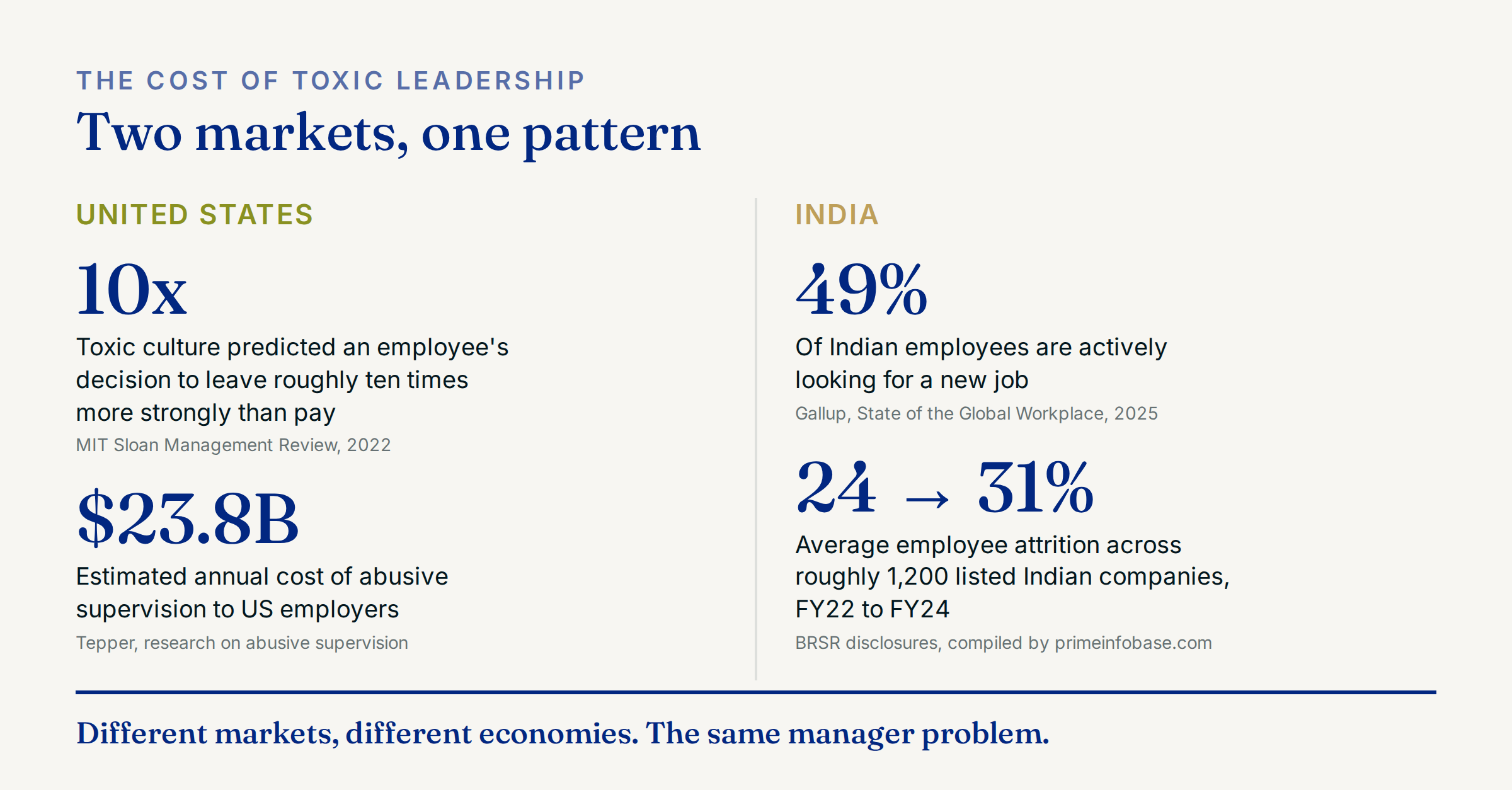
In the United States, MIT Sloan researchers looking for what drove the wave of resignations after the pandemic found that a toxic culture predicted an employee's decision to leave roughly ten times more strongly than pay did.[2] Tepper's own research puts the annual cost of abusive supervision to US employers at close to $23.8 billion, in lost productivity, absenteeism and turnover.[3]
The picture in India is at least as stark, and it deserves equal billing rather than a footnote. Gallup's most recent workplace survey found that 86% of Indian employees describe themselves as struggling, and that 49% are actively looking for another job.[4] A 2025 corporate wellness study covering more than a thousand Indian companies found a similar number, 86%, reporting mental health struggles at work, which the authors translate to roughly 4.3 crore people.[5] And the business cost is visible in the numbers Indian companies now have to disclose: across nearly 1,200 listed firms, average employee attrition rose from 24% in FY22 to 31% in FY24.[6] Two markets, different in almost every other way, telling the same story about what a bad manager costs.
Numbers like these make it tempting to reach for the simplest explanation. Somewhere out there is a type of person, and organisations keep accidentally hiring or promoting them. It's a comforting story, mostly because it asks nothing of the rest of us, and the evidence doesn't support it. Most people who end up leading badly did not set out to. Understanding how they got there is the more useful question, and a more honest one.
What We Absorb, Including From Our Own Pain
Leadership is learned largely by watching, long before anyone is handed a team of their own, and much of that learning happens without a conscious decision being made. Research tracking behaviour across several levels of a company found something specific: hostile behaviour at the top predicted hostility one level down, which then predicted hostility inside teams two levels below that.[7] Bad leadership travels downward through an organisation the way water finds its way down a hill.
This raises a harder question, and it's the one you've probably noticed yourself. What about the person who was actually on the receiving end, who suffered under a bad boss and swore they'd never become one, and did anyway?
Research aimed directly at this found something specific and useful. Having a bad boss doesn't reliably turn someone into one. What matters is whether that bad boss was also seen as successful. New leaders were far more likely to repeat abusive behaviour when the person who modelled it had visibly delivered strong results, and when the new leader had already come to believe, rightly or wrongly, that toughness bordering on harshness was simply what strong leadership required.[8]
In other words, the wound alone doesn't explain it. What explains it is a lesson quietly drawn from the wound: this is what it costs to win here, and I intend to win. That is not someone repeating pain for its own sake. It is someone concluding, often without examining the conclusion very closely, that the method and the outcome were connected.
What Power Quietly Takes Away
Suppose someone escapes all of that. They had genuinely good managers, they paid close attention, and they carry a clear picture of the leader they want to be. Even they are not fully safe, because power itself changes people in ways that have nothing to do with what they intended.
Researchers who study power have found a consistent pattern: the more power someone gains, the less attuned they tend to become to how the people around them are feeling.[9] It isn't that they stop caring. It's that a kind of quiet noticing, the ability to read a room and sense when someone is struggling, fades once a person no longer has to rely on it to get by. One well-known summary of this research compared the effect, only half-jokingly, to a mild brain injury: people with power tend to become more impulsive and less able to see a situation from someone else's point of view.[10] The manager who once read a room effortlessly and now seems oblivious to it hasn't necessarily changed what they believe. The instinct they used to rely on has simply gone quiet, usually without them noticing it happened.
What Stress Wears Down
Even without power in the picture, most people are worse versions of themselves when they're depleted, and management is a role that depletes people often. Self-control behaves like a resource that gets used up over the course of a hard day, and once it's spent, the impulses a person would normally hold in check get harder to hold.[11]
The research on this gets specific enough to be uncomfortable. One study tracking managers day by day found that a bad night's sleep reliably predicted more abrasive behaviour the following day, which then showed up in how disengaged their team felt.[12] There's a name in the literature for the everyday version of this, sometimes called the kick-the-cat effect: pressure absorbed from above gets discharged on whoever is standing below. None of this excuses the behaviour. But it does mean that a large share of toxic moments are not decisions in any real sense. They are the failures of a tired, overloaded person to be the manager they actually intend to be.
When the Wrong Thing Gets Rewarded
Now consider a different person altogether, one who isn't drifting or depleted at all. They've watched the people who behave badly in their organisation get promoted, and they've drawn a cold, deliberate conclusion: this is what it takes here, so this is what I'll do.
It's a rational-sounding calculation, and it deserves a rational answer rather than a moral one. A long-running study that tracked professionals for roughly fourteen years found that selfish, combative, manipulative people were, on average, no more likely to reach positions of power than generous, trustworthy ones.[13] The aggressive behaviour did buy some advantage, but it was consistently cancelled out by the weaker relationships it produced along the way, leaving no net gain.
Toxic operators are memorable precisely because they're toxic, which is exactly why they seem to be everywhere succeeding. On average, they aren't. Where a specific organisation genuinely does keep promoting its worst-behaved people, that organisation has diagnosed its own disease in the clearest way possible. But the wider belief that toxicity is the price of success is, for most people in most places, a costly misreading of what they've seen.
The Preparation That Never Came
Set the last four causes side by side and one question becomes unavoidable. What are organisations doing to prepare people to withstand any of this? For the most part, remarkably little.
Research from the Chartered Management Institute found that 82% of people who move into management do so with no formal training of any kind.[14] The same research found that a meaningful share of managers, when asked how promotions actually get decided where they work, pointed to internal relationships and visibility rather than ability.[15] That perception isn't the whole truth, and it shouldn't be read as one.
Plenty of promotions are earned the honest way, through real credibility built over years of good judgment and delivered work. But perception still matters here, because when even a significant minority of managers believe the path upward runs through relationships rather than results, that belief shapes how they behave once they're the ones being watched.
The same CMI research found that managers who had actually received training were noticeably more willing to confront bad behaviour rather than wave it through, which suggests the instincts we tend to treat as innate are, to a meaningful degree, teachable. When the teaching doesn't happen, stress, precedent and habit make the decisions instead, and we've already seen where those tend to lead.
The Last to Know
There's a final piece, and it's the one that makes the whole pattern so hard to interrupt from the outside. Most people leading badly do not know that they are.
Research on self-awareness found that while roughly 95% of people believe they see themselves clearly, only 10 to 15% actually do.[16] The same research found that the more power a person holds, the wider that gap tends to grow. So the people most likely to be drifting are also the least equipped to notice it, and the least likely to be told, because honest upward feedback is exactly the kind of thing that power and hierarchy tend to suppress. The toxic boss is very often the last person in the room to find out.
The Framework, and Why It's Hopeful
Put the six causes together and a shape emerges. Three of them live inside the person, mostly outside their conscious control: what they absorbed, including from their own pain, what power took from their empathy, and what stress wore down in their self-control. Two of them live inside the organisation: rewarding the wrong behaviour, and never teaching the right one. And one lives in the gap between the two: a blind spot that hides the drift from the person best placed to fix it, at exactly the moment it matters most.
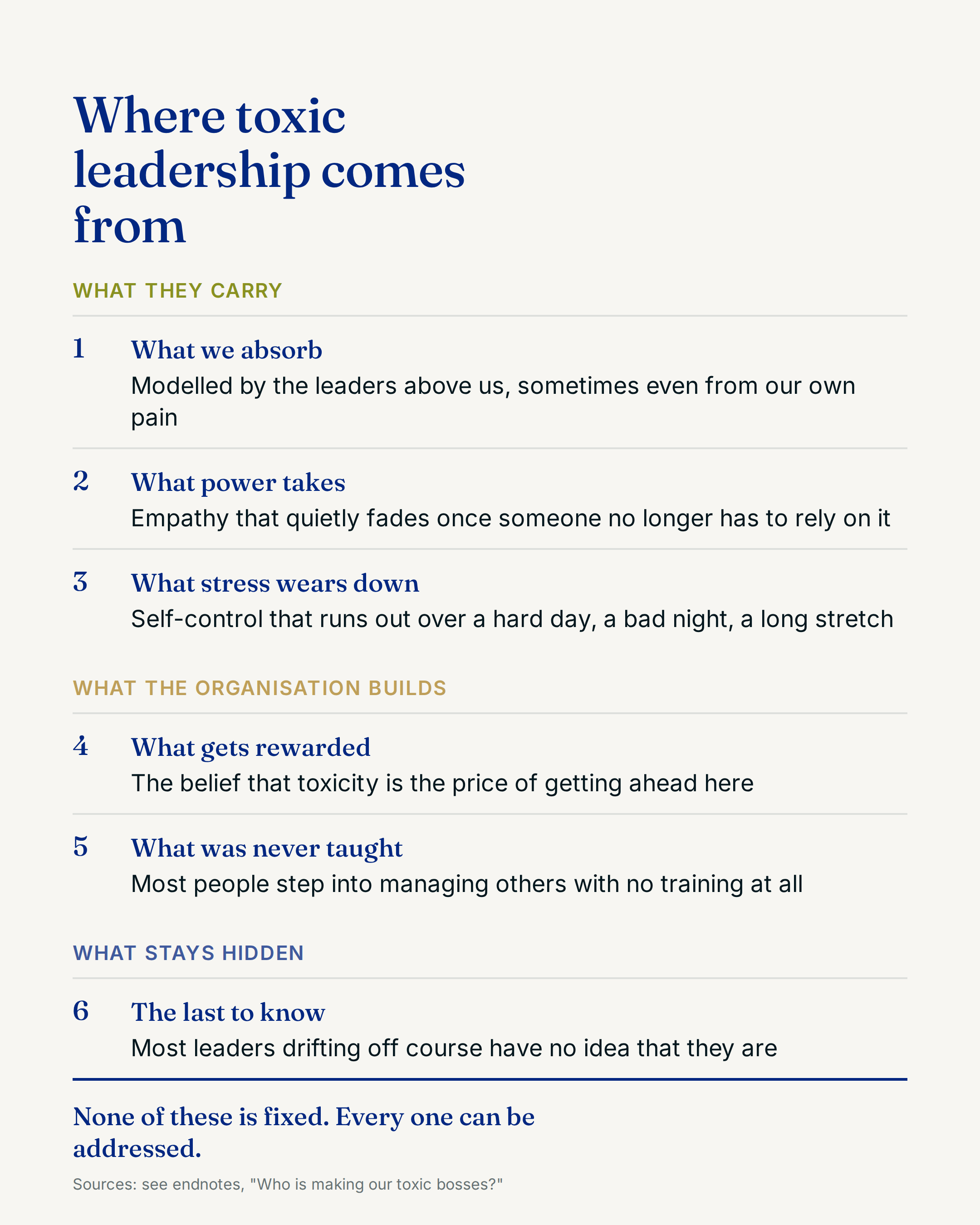
Read as a list of excuses, this would be a bleak piece. Read correctly, it's the opposite. Every cause on this list describes something built, which means every one of them can be addressed. What was absorbed can be replaced with better modelling. What power erodes can be protected through structured feedback the person actually trusts. What stress wears down can be supported before it breaks. What gets rewarded is a choice an organisation makes, and can unmake. What was never taught can be taught. And the blind spot, the hardest of the six, can be lifted, but only by people whose honesty a leader has learned to trust before the stakes get high.
That is the real argument for taking the development of leaders seriously, and for starting well before the title changes. Not because bad bosses deserve sympathy, but because most of them were never actually given a fair chance to be anything else.
Endnotes
- Bennett J. Tepper, "Consequences of Abusive Supervision," Academy of Management Journal, 2000.
- Donald Sull, Charles Sull and Ben Zweig, "Toxic Culture Is Driving the Great Resignation," MIT Sloan Management Review, 2022.
- Bennett J. Tepper and colleagues, research on the prevalence and organisational cost of abusive supervision, cited widely across US workplace research.
- Gallup, State of the Global Workplace, 2025.
- CII and MediBuddy, Corporate Wellness Index, 2025, based on data from over 1,000 Indian companies.
- Business Responsibility and Sustainability Reporting (BRSR) disclosures across roughly 1,200 listed Indian companies, compiled by primeinfobase.com, FY22 to FY24.
- Mary Mawritz and colleagues, research on the cascading effect of abusive supervision across organisational levels, Personnel Psychology, 2012; see also Samuel Aryee and colleagues, Journal of Applied Psychology, 2007, and the underlying social learning theory of Albert Bandura.
- Min-Hsuan Tu, Joyce Bono, Cass Shum and Liva LaMontagne, "Breaking the Cycle: The Effects of Role Model Performance and Ideal Leadership Self-Concepts on Abusive Supervision Spillover," Journal of Applied Psychology, 2018.
- Research associated with Dacher Keltner on power and social attunement, and Sukhvinder Obhi on power's effect on neural processes linked to empathy.
- Jerry Useem, "Power Causes Brain Damage," The Atlantic, 2017, summarising the research above.
- Roy Baumeister and colleagues, research on ego depletion and the limits of self-control.
- Christopher Barnes and colleagues, research linking managers' sleep to next-day abusive supervision and team engagement, Academy of Management Journal, 2015.
- Cameron Anderson, Daron Sharps, Christopher Soto and Oliver John, "People With Disagreeable Personalities... Do Not Have an Advantage in Pursuing Power at Work," Proceedings of the National Academy of Sciences, 2020.
- Chartered Management Institute and YouGov, Taking Responsibility: Why UK Plc Needs Better Managers, 2023.
- Chartered Management Institute and YouGov, 2023, as above; 46% of managers surveyed believed promotions in their organisation were driven more by internal relationships and visibility than by ability.
- Tasha Eurich, research on self-awareness, Harvard Business Review, 2018.
A note on sources: every figure above is attributed to the study or organisation that produced it. Where a finding is well established across multiple studies, the endnote says so rather than naming a single paper.