
An ambiguity that serves everyone except the person it was meant to develop


In June 2026, investors valued SpaceX at around $1.5 trillion in the largest public offering in history. The company had lost close to $5 billion the year before, and commentators openly called the listing a referendum on Elon Musk's leadership. A few months earlier, and a world away, Deepinder Goyal raised $54 million for a venture called Temple at a valuation of roughly $190 million, for a company still in stealth with no product on the market. In his own words, the people who put money in wanted in whether or not Temple ever makes it to market.
Ask what those investors were actually buying. It wasn't last year's earnings, because in both cases the earnings argued the other way. They were buying human capability, the founder and the team and what that combination might yet build. The market prices that capability in the billions, and does so eagerly.
Now look at the balance sheets of those same companies, and you won't find it anywhere. The most valuable thing a business owns is the one thing its own accounting refuses to record. There is a reason for that, and it runs deeper than most people think.
Why Capability Can't Sit on the Balance Sheet
Under IAS 38, and its Indian equivalent Ind AS 38, an item has to clear three tests before it can be recorded as an asset. It has to be identifiable, the company has to control it, and future economic benefit has to be expected to flow from it. A patent clears all three, which is why a patent sits on the balance sheet.
Now run a leadership programme through the same three tests. It's identifiable, and the benefit is real, since better leaders build better companies. But control fails completely, because the people you develop can resign tomorrow and carry that capability across the street. Since control fails, the spend cannot be capitalised. It lands in the profit and loss account in the year it is spent, and then, as an accounting object, it simply disappears.
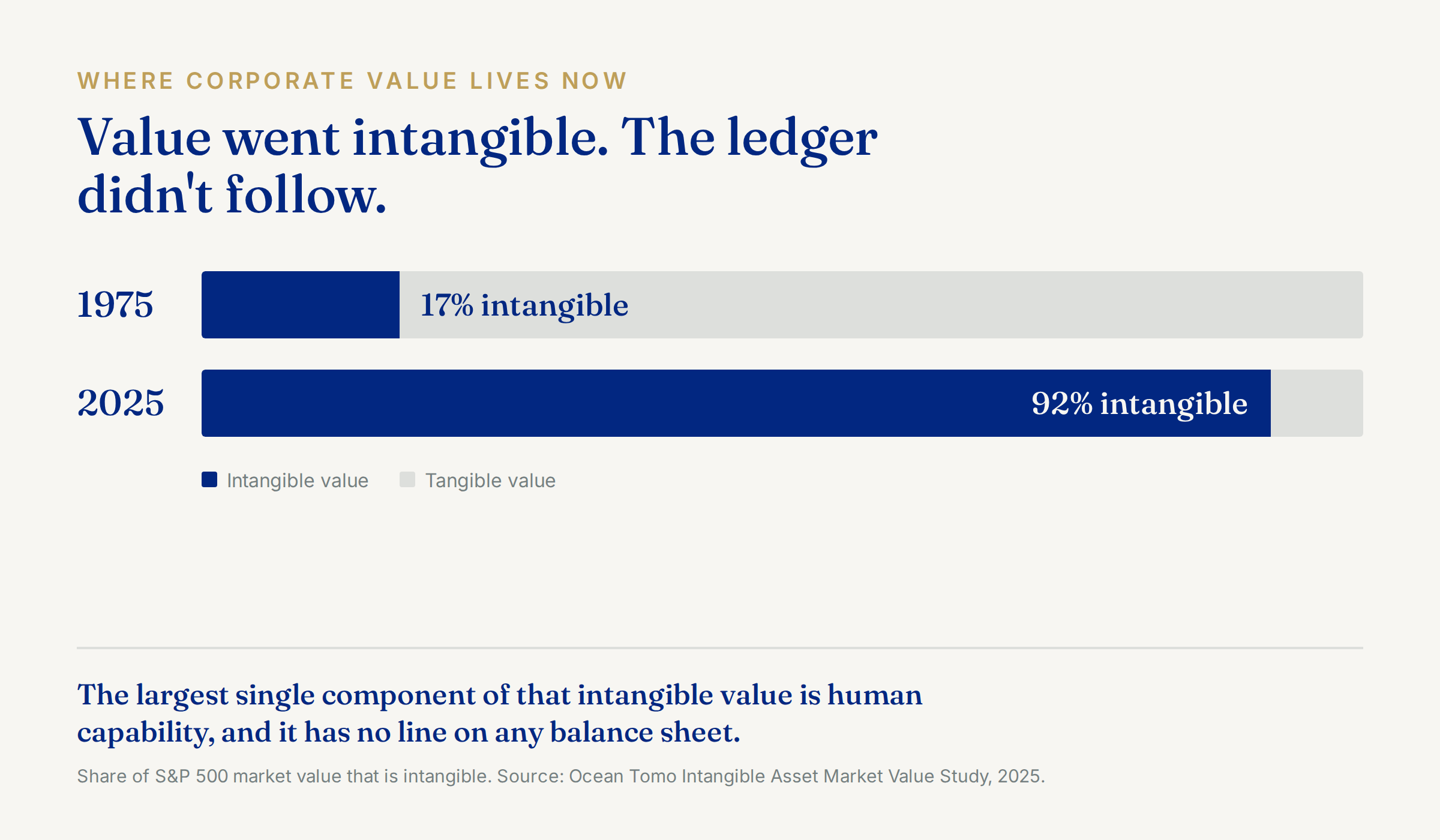
This is no small rounding error. Intangible assets now make up around 92% of the market value of the S&P 500, up from roughly 17% in 1975, and the largest single component of them is human capability. The thing that most explains what a modern company is worth is the thing its own books are structurally blind to.
That also reframes something we usually treat as a moral failing. When a company cuts its learning budget by 40% in a hard quarter, that is not malice, and it is not short-sightedness of the kind people enjoy accusing it of. It is the only move the rules allow, because a cost with no asset to show for it is the easiest cost in the building to defend cutting. The accounting doesn't just permit the cut. It quietly recommends it.
The Money That Survives Rarely Reaches the Work
Suppose the budget survives. Even then, most of the spend never reaches the job. Decades of research on training transfer, going back to Fitzpatrick's 2001 review and a great deal of behavioural work since, suggests that only 10 to 20% of what is taught is ever actually applied at work. The rest evaporates somewhere between the room and the desk, not because people don't care, but because almost nothing is built to carry a lesson from the one to the other.
Then layer forgetting on top of the transfer gap. Hermann Ebbinghaus mapped in 1885 how quickly the mind sheds newly learned material, and his forgetting curve has held for well over a century. Most of what we absorb in a concentrated burst is gone within a month unless something deliberate brings it back. Put the two together, and proving real, lasting change from a conventional programme becomes very close to mathematically impossible.
The Fog Equilibrium
You would expect a market to correct something this leaky, and it doesn't. The reason isn't really dishonesty. It's incentives that quietly point the same way for everyone in the room.
Picture a result being presented to a board. A single confident, flattering number fills the screen and reassures everyone. An honest range, with its assumptions and its uncertainty on show, invites hard questions instead. Under pressure the confident number tends to win, whoever is holding it, because it is easier to carry into a difficult meeting than the truth. And once the cheque clears, nobody audits. The finance team doesn't have the tools, and the people who ran the programme are never going to volunteer proof that it fell short. So the claim is made once and never revisited, and the incentive to inflate it never goes away. The corporate world ends up measuring what protects budgets rather than what actually changes people.
This is what I have come to call the fog equilibrium, and equilibrium is the right word. The ambiguity is not an accident that better software will one day clear up. It's a stable arrangement that serves the provider, whose flattering claim survives; the internal team, whose budget is safe because a programme that is never measured can never be judged a failure; and the buyer, whose decision is never audited and so never has to be defended.
The One Person the Fog Doesn't Serve
It shields the budget, the programme and the decision, all at once. Seen that way, the ambiguity looks less like a flaw in how we develop people and more like the product.
It shields everyone in the room, that is, except the one person the whole exercise was for. The employee whose growth the money was meant to fund receives a development that mostly doesn't transfer, mostly fades, and is never measured closely enough for anyone to notice that it didn't work. Every other party has a quiet reason to prefer the fog. They are the only one who pays for it.
None of this says that people cannot be measured honestly. The tools exist, and the evidence to build on is not hard to find. The harder question is the one the fog is built to keep us from asking. It was never whether we can measure the development of people honestly. It is who, given how comfortable the fog is for everyone standing in it, is actually willing to.
Endnotes
- SpaceX's initial public offering, June 2026, was the largest in history, valuing the company at roughly $1.5 trillion; SpaceX had reported a loss of close to $5 billion for 2025, and market commentators widely described the listing as a referendum on Elon Musk's leadership. Reporting: Reuters, CNBC and CNN, June 2026.
- Deepinder Goyal's venture Temple raised $54 million in February 2026 at a post-money valuation of about $190 million, while still pre-product and in stealth. Goyal stated publicly that his backers wanted in "whether or not Temple ever makes it to market." Reporting: Business Today and TechCrunch, February 2026.
- IAS 38, Intangible Assets (International Accounting Standards Board), and its Indian equivalent, Ind AS 38. The three recognition criteria referred to are identifiability, control, and the expectation of future economic benefits.
- Ocean Tomo (a part of J.S. Held), Intangible Asset Market Value Study, 2025. The study puts intangible assets at roughly 92% of the market value of the S&P 500, compared with about 17% in 1975.
- Kenneth Fitzpatrick (2001) and a substantial body of subsequent behavioural research on training transfer, commonly summarised as only 10 to 20% of training being applied on the job. Estimates vary across studies and settings; the figure is best read as a well-supported range rather than a single precise number.
- Hermann Ebbinghaus, Über das Gedächtnis (translated as Memory: A Contribution to Experimental Psychology), 1885, the origin of the forgetting curve.
A note on sources: the figures above are drawn from the primary studies, standards and reporting named. Where a finding rests on a body of work rather than a single paper, as with training transfer, the endnote says so.