
Whose CV is it, anyway?


Part one of two. This part asks the question. Part two asks what a right to your own evidence would actually take.
Across India's major IT services firms, industry trackers put the toll at close to 80,000 jobs cut over an eighteen-month stretch through 2025, and unlike the layoffs of a decade ago, this round was not concentrated among the youngest or newest employees. The cuts specifically targeted middle and senior management, the layer that had become the most expensive to keep and, on paper, the most replaceable.¹ Somewhere in those numbers was a delivery head who had spent eleven years turning around accounts nobody else wanted, and a manager who had quietly mentored a dozen younger engineers into leadership roles of their own. None of that appears anywhere in what they were handed on the way out.
What they were handed, in almost every case, looks the same. A relieving letter. A final designation and a set of dates. Perhaps a reference letter with three sentences of praise so generic it could describe anyone who ever held the job. That is the entire record of everything they built, for people the company itself was, until a few months ago, ranking, rating and rewarding based on precisely how well they built it.
The same mechanism, one floor up
We tend to reach for the gig economy when we talk about lost ratings, an Uber driver deactivated by an algorithm, a home services professional whose five-star history disappears the day she leaves the platform. But the identical failure happens one floor up, in glass office towers, to people earning many multiples of what a driver earns. A senior manager's annual appraisal is a rating. Her 360-degree feedback is a rating. The calibration conversation that decided her bonus last year was, in every meaningful sense, the same mechanism that decides whether a delivery partner keeps getting bookings. The only difference is the name it goes by and the length of the wait between cycles. And just like the delivery partner, none of it travels with her. Years of documented performance reviews sit inside an HR system she will never be able to log into again the day she leaves, for any reason, including a layoff that had nothing to do with how well she did her job.
What the company loses too
This is worth a CHRO's attention as much as anyone's, because the company is not the quiet beneficiary of this gap. It is a second victim of it, just a slower and less visible one.
Start with what a company already knows about its own people and still fails to use. McKinsey's own research on internal mobility finds that more than 80% of role moves at large organisations involve changing employers entirely, meaning most open roles go to someone the company has no performance history on, while people with years of internally documented, calibrated proof of capability are passed over because that proof was never built to be visible outside the team that generated it.² A company can run a rich, careful appraisal system for a decade and still lose the thread on its own best people, because the record was built to justify a bonus once a year, not to be searched or surfaced when a role opens two floors away.
Now extend that same blindness past the exit door. Harvard Business Review's analysis of three million employee records across more than 120 companies found that 28% of all new hires are boomerang employees, people rejoining a company they once left, and that firms actively court them because a documented track record is worth more than an unknown one.³ That finding only makes sense if track record is valuable enough to hire on. It also quietly proves the cost of losing it. Every departing employee whose record disappears into an inaccessible archive is a potential future boomerang hire, referral or client that the company has made needlessly hard to identify, by its own choices about where that record is allowed to live.
Add the two findings together and the picture is not flattering to anyone. Companies struggle to see the talent inside their own walls, and the moment someone leaves, whatever thin visibility existed disappears completely, for the company as much as for the person. Nobody sat down and designed it this way. Performance systems were built to run a company well in a given year, not to stay searchable once someone's badge stops working.
The market cannot tell the difference
Reporting on India's hiring market this year also points to a related shift: departures are increasingly framed in softer, less specific language than a straightforward layoff, described instead through terms like relevance or restructuring, and hiring firms now estimate tens of thousands of people have moved on this way in the first half of the year alone.⁴ Whatever the reason behind any individual departure, the effect on the record is identical. The market has no reliable way of telling one departing professional apart from another. It cannot distinguish the person who left because a client relationship ended from the person who left because, on paper, she was the best account manager the firm had.
This is not a hypothetical cost, and it is not only the departing employee's cost either. Ofer Sharone, a sociologist at MIT who has spent years studying long-term unemployment among highly educated professionals, describes precisely this trap in his research: unemployment strips experienced, well-credentialed workers of the ability to have their own track record read as an asset, because from the outside, a career gap looks identical whether it was caused by a business decision or a performance one, and employers routinely prefer a candidate who is already working over one who is not, for exactly that reason.⁵ The person who did the best work of her career in the years before the layoff and the person who did the weakest both walk into the job market holding the same blank page. The market cannot price the difference between them, so it stops trying, and falls back on cruder signals instead: which company you last worked for, how recently, how old you appear to be.
The next employer pays for this blindness too, in money it can count. McKinsey puts the average cost of replacing a hire who does not work out at roughly $52,000 once recruiting, onboarding and lost productivity are included, with specialised or senior mis-hires running well beyond that.⁶ Most of that failure traces back to the same root cause: the employer had no reliable way to see what the candidate had actually done, only what she claimed and what a reference chose to say in a five-minute call. Seniority raises the stakes further, since director and executive searches already take roughly twice as long to close as searches for individual contributors, precisely because there is less evidence available to get the decision right.⁷
Gen Z is already asking for this, just not by this name
The generation now entering management has made an unusual amount of noise about transparency, and it is worth asking why that demand has stopped at pay. Deloitte's 2025 Gen Z and Millennial Survey found that 44% of Gen Z rank pay transparency and fairness as their single most important job factor, ahead of flexibility and traditional benefits.⁸ That is a workforce rejecting the idea that important information about their working lives should stay locked inside a company with no obligation to share it. It is a short step from demanding to see what you are paid to demanding to keep what you have proven, and almost nobody has taken it yet.
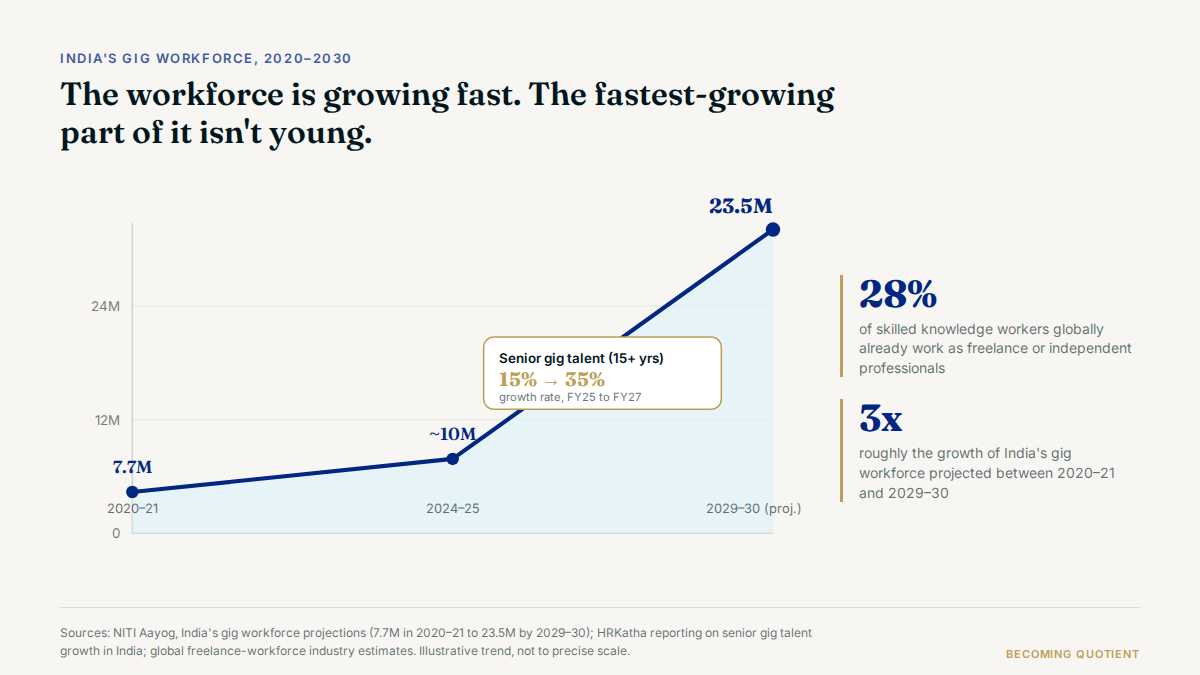
The step is becoming harder to postpone. India's gig workforce is projected to nearly triple from around 7.7 million in 2020-21 to 23.5 million by 2029-30, and the fastest-growing segment within it is not the youngest entrants but senior professionals, with independent work among people with fifteen or more years of experience forecast to more than double in two years.⁹ Globally, roughly 28% of skilled knowledge workers already describe themselves as freelance or independent.¹⁰ A generation insisting on transparency about pay is about to become a workforce that moves between employers constantly, on evidence alone, with no equivalent insistence yet on transparency about the record of its own work.
A decade of precision, gone in a day
A company can spend a decade rating, reviewing and rewarding a person with real precision, building a genuinely rich picture of what she is capable of, and the moment the relationship ends, for whatever reason, all of that precision goes dark. Not just for her. For the company too, which loses the ability to ever point to it, lean on it, or let a departing employee carry it forward as proof of the culture it is actually trying to build. Both sides are left holding the same title and the same date, unable to prove or use any of the years that made the relationship worth having.
Nobody designed it to work this way. Performance systems exist to run a company well, not to travel with a person. The next question, worth asking properly rather than gesturing at, is whether that is simply how modern work has to be, or whether it is a right that already exists on paper and has just never been read this way, one that would serve the company building the record just as much as the person it describes.
Part two looks at that right directly, and at what it would actually take to build.
Endnotes
- Industry and analyst reporting through 2025 on cumulative workforce reduction across major Indian IT services firms, cutting close to 80,000 roles over an eighteen-month period, with cuts disproportionately concentrated in middle and senior management. Reporting: CIO, Gallup's State of the Global Workplace 2026.
- McKinsey & Company, A new operating model for people management: More personal, more tech, more human, finding that more than 80% of role moves at large organisations involve changing employers rather than internal redeployment, despite existing internal performance data on the employees passed over.
- Anthony C. Klotz and Andrea Derler, "The Promise (and Risk) of Boomerang Employees," Harvard Business Review, March 2023, based on an analysis of roughly three million employee records across more than 120 companies from 2019 to 2022, finding that 28% of new hires were boomerang employees.
- Reporting on the rise of undisclosed or informally framed layoffs in India through the first half of 2026, drawing on hiring-industry estimates of the scale of quiet departures.
- Ofer Sharone, The Stigma Trap: College-Educated, Experienced, and Long-Term Unemployed (Oxford University Press, 2024), on how unemployment renders an experienced professional's own track record illegible to the market.
- McKinsey & Company research, cited across industry hiring-cost analyses, estimating the average cost of replacing a hire who does not work out at approximately $52,000 once recruiting, onboarding and lost productivity are included, with senior and specialised mis-hires running considerably higher.
- Labour market data on job search duration by seniority, showing executive and director-level searches taking roughly twice as long to close as individual-contributor searches.
- Deloitte, 2025 Gen Z and Millennial Survey, finding that 44% of Gen Z rank pay transparency and fairness as their most important job factor, ahead of flexibility and traditional benefits.
- NITI Aayog data on India's gig workforce, projecting growth from approximately 7.7 million workers in 2020-21 to 23.5 million by 2029-30; HRKatha reporting on senior gig talent (15 or more years of experience) as the fastest-scaling cohort in India's gig market.
- Industry data on the share of skilled knowledge workers globally who describe themselves as freelance or independent professionals.
A note on sources: the figures above are drawn from the primary studies, reporting and named institutions cited. Where a finding rests on a broader body of work rather than a single paper, the endnote says so.